Winter 2026 Field Report
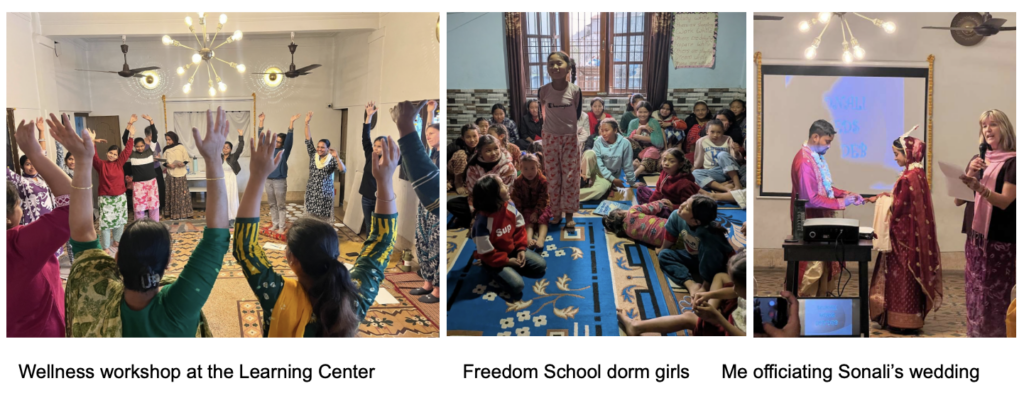
I have just returned from a month-long trip to India and Nepal – a challenging, joyful experience in which we launched two new programs, celebrated the wedding of an HFC graduate, and got inspired with new ideas.
The trip started in Kolkata – our headquarters – where the majority of program staff (10) and core partner organizations (6) are based. As a team and with our partners, we spent a lot of time on this trip brainstorming about how we can best meet the evolving needs of trafficked and high risk girls in West Bengal.
West Bengal is a hotspot for sexual and gender-based violence. It is one of the five states in India with the highest rates of gender-based violence. Indigenous women, Dalit women (once called untouchables), and ethnic and religious minorities – such as Muslim and Christian Adavasi girls and women – are the most affected, and so these are the people HFC aims to reach.
What has changed?
Things have changed a lot in India since HFC began working there 20 years ago. In the anti-trafficking space, the biggest change is that the Indian government no longer allows long-term shelter stays for rescued girls. In the past, we would typically have girls living in our shelters for 5 or 10 years. They grew up in the shelters and received education, counseling, legal aid and other services over a long period. Now the average stay in rescue shelters is 3 months, as girls are restored as soon as possible to relatives.
Trafficking routes and the destination points have also changed. In past years, Nepali girls were primarily trafficked for slavery in Indian red light areas, as described in the book Standing in the Way (written by HFC graduate Anjali Tamang and me). Today Nepali girls are more often trafficked for domestic labor in private homes, particularly in Delhi. Children working as maids are terribly vulnerable: they are often sexually abused by their employers. They run away to escape the abuse and end up exploited in red light areas, so even though the route is different, the end result is the same. Trafficking from Bangladesh and from rural to urban areas has also increased.
How HFC is adapting:
To remain impactful, we have to stay on top of these trends and continually evaluate and adapt our programs to meet changing needs. One way we are doing this is through our red light area Resource Centers. Families in the red light area share one room in the brothel, so children are at extreme risk for being abused by their mother’s clients and being trafficked when they reach their early teens. In the past, girls were often removed from their moms and raised in shelter homes.
Now that long term shelter care is not an option, we are working with our local partners to keep girls safe in a different way: they come to our Resource Centers while their mothers are seeing customers. At the Centers, they receive all the services – education, counseling, a safe place to study, play or rest – that they need to stay in school and break the cycle. It’s a beautiful thing to help families stay together. Moms often start by sending their children to the Centers, and eventually come for services themselves. To build on the lifeline that the Resource Centers are providing, this year we are purchasing a building in one Kolkata red light area, where we will be able to grow all of these services, and add a night shelter for short term emergency care.
To address the increase in trafficking from Bangladesh and rural West Bengal, we are opening a Learning Center in South 24 Parganas, a rural area near the Bangladesh border. Our Country Director John Das is leading the charge on this new project, which will also house his social enterprise Stitch for Freedom – HFC’s newest partner organization.
We hosted some truly amazing volunteers on this trip – one group from the US through a collaboration with Yoga Medicine SEVA Foundation, and another from Wales through a collaboration with The URDD. Photographer/Filmmaker Paul Chelmis was also there, making a new short film for HFC, which will premiere at our gala in Charleston April 16. The volunteers brought a wide range of skills and activities, from watercolor painting to (of course!) yoga, weaving, loom bracelets, folk dancing, Welsh-themed crafts (dragons!) and baking. The kids LOVE it when people visit and share their energy, talents and love. Check out our upcoming immersion trips here.

Her Future Middle School by Ektara
The Middle School, operated in collaboration with our long-time local partners at Ek Tara, offers 200 girls a year from Kolkata’s largest slum community the means to break free from extreme poverty and high risk of exploitation. We enjoyed a lovely day at the school leading a workshop on issue-based art and artists, and making art trading cards.
Located in Topsia, the largest slum in West Bengal, the school is situated near railway tracks, along which many of our families live in tin shacks, or dilapidated apartment buildings. Topsia is a traditional Muslim community. Many families are migrants from the neighboring state of Bihar.Before EkTara came to the community in 2011, education for girls was not a priority, because of large family size, poverty, and cultural norms. Many women in the area are ragpickers, meaning they go through heaps of garbage looking for plastic and other saleable items. Students at our school used to participate in this dangerous and degrading work. Girls in this area are also at high risk for trafficking, child marriage and extreme domestic violence. But now, 200+ girls are getting a top quality education in our middle school, and over a thousand more in preschool through high school. (HFC has sponsored the education of girls at EkTara since 2011)
Jalpaiguri Shelter
Jalpaiguri shelter was built by HFC in 2015, expanded in 2017, and is operated by Women’s Interlink Foundation. Over the past decade, HFC has supported vocational training at the home as well as education and shelter care. Jalpaiguri is in a high trafficking region near the borders of Nepal and Bangladesh. Many of the survivors who have found refuge at this shelter were trafficked from Bangladesh or Nepal, or were engaged in child labor in the local tea farms, where they also experienced sexual violence.
I spent several days at the Home with Fifi Teaching Fellow Sarah Schumann, offering workshops in arts and English, joining girls and staff on a picnic where we played fun and raucous games. It’s always really special to spend time with the girls whose futures we are working to secure. To see them growing up safe, happy, confident and strong is the greatest gift, and makes all the hard times worthwhile.
Success stories: We got to celebrate with 5 young women who grew up in this shelter, educated through our school sponsorship program, and then trained in a sewing course at the shelter after high school. They have been selected for coveted jobs in a government-sponsored employment program. They will be living in Bangalore in company housing, and will get excellent salaries and even a pension plan! They are super excited and we are very proud of their hard work and determination. Congratulations Juli, Shampa, Prerona, Loki and Payel! Two other girls from our sponsorship group won scholarships to a prestigious private school. We were so grateful that the shelter home staff arranged for them to come back for the weekend so we could spend time with them.
New Healing & Wellbeing Curriculum
Our Mental Health Program Director Tish Roy was also in India in February, piloting a new Wellbeing Program. The 8 session course – which offered tools for emotional self-regulation and active listening, among others – was extremely well received by the participants. We are hopeful that the women in these two groups will continue meeting and supporting each other as a women’s self-help collective.
“After coming here, I feel like there are people with whom I can share my heart’s deepest sorrows and worries of the day. I have learnt so many new techniques. I can’t explain the joy and happiness that I got from this program, it is the most I have felt in my life, more than receiving gold, gifts etc. I will teach my daughter whatever I have learnt from here. Before, if there were any arguments, I used to argue back, but after this program I know that there are steps which I need to do before responding. I have benefitted so much. I used to lie sleepless for months, I stayed awake, but this last month really helped me to sleep. I have a lot of diseases and used to think that I would die, but now I know that death is not the answer, but my aim is to make my daughter grow up well”
Freedom School
After the joyous chaos of Kolkata, I traveled to the Freedom School in rural Nepal. The school is located in Nuwakot – a district hard hit by trafficking, with 75% of girls either trafficked to India for brothels or domestic labor, or forced into child marriages to avoid them being trafficked. The project was founded and is led by Anjali Tamang, a survivor and anti-trafficking activist who was in HFC programs for many years, and my beloved daughter. Ever since she was rescued in 2009, Anjali had the dream to open a school in her village to prevent the next generation of girls from being trafficked, and having to suffer as she did. Her dream seemed wildly ambitious when she was 15 and living in a shelter home in Kolkata, but the dream has come true and it is even more than we hoped.
The Freedom School opened in 2021 and is now serving over 200 kids and young women – aged 2 to 21, including 45 residential students (girls who are at the most imminent risk of trafficking and live too far to walk).
Thankfully, we have been able to expand our physical space to accommodate the increase in students. We closed off the roof deck in the larger school building, making two larger classrooms for our largest age groups, and we have begun construction on a whole new school building, which will provide larger classrooms for all grades. We replaced our school bus with a newer (but still used) bus, as so many of our kids live in the upper villages and need the bus to get to school.
Apart from the changes in population and physical space, there has been remarkable progress in the children’s educational level, and in the complexity of material taught. For example in the nightly Zoom classes taught by Miss Robin and her team, kids were learning their times tables and simple prepositions when they started:
‘The pencil is UNDER the chair’. The classes I joined last month included a session on alcoholism and its effect on the different parts of the brain: ‘The AMYGDALA is the part of the brain which processes emotions, and alcohol can make it harder to control your emotions’
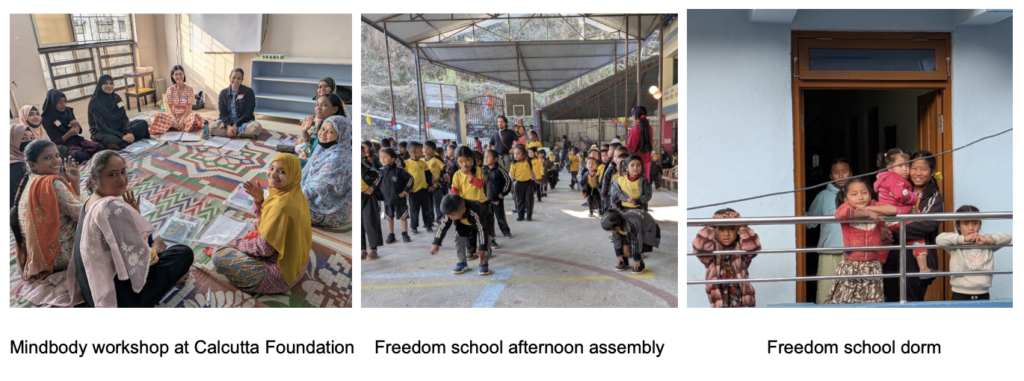
Beyond providing high quality education, Anjali is committed to changing the mindset of the community around trafficking, the value of education and the value of girls. The change she has brought about in just 5 years is breathtaking. Attitudes in the community are changing, and girls whose sisters, mothers and aunts are in the brothels of India, are going to school and thriving.
My last few days in Nepal were spent in Kathmandu, visiting our long time partner Apple of God’s Eye (an HFC partner since 2008). Many of the girls we sponsored for school at Apple are now in college, or have graduated from college. They are launching into the world as professionals, changemakers and advocates. All of the HFC girls attending college – in Kathmandu, Kolkata or Kenya – are living proof that this dream is working, and that more transformation is possible if we keep dreaming and working together.
Thanks for reading this report, and for being a partner and friend on this long, sometimes hard but always beautiful journey!
Love, Sarah
More about gender-based violence in India Source: Mapping Gender Violence in India, Council for Justice and Peace
The Council of Europe defines gender-based violence as “violence based on an imbalance of power, carried out with the intention to humiliate and make a person or group of people feel inferior and/ or subordinate. This type of violence is deeply rooted in the culture, norms and values that govern society, and is often perpetuated by a culture of denial and silence”.
Many SGBV cases go unreported due to fear of stigma, lack of trust in law enforcement, and inadequate support systems. This is further exacerbated by government officials who blame victims, questioning their morality. Even when reported, police investigations are often delayed and inadequate. Officers often lack empathy or form any sort of respect for the survivor’s needs, leading to a lack of justice — and this failure is systemic because of administrations’ incompetence to train officers in gender sensitivity. Often the police refuse to register cases if the perpetrator is influential — or if the victim does not fit the ideal of one.
Law enforcement officers may exhibit biases against survivors, and may even engage in victim-blaming, therefore leading to victims making the decision to avoid this added trauma altogether. Even when perpetrators are convicted, sentences may be lenient, sending a message that such violence is not taken seriously. Many judicial officers and lawyers may lack adequate training and awareness regarding GBV, leading to insensitive handling of cases and perpetuating harmful stereotypes.
‘Dalit women and girls are predominantly targeted (rape and gang rape) by men belonging to higher castes. Often, these atrocities are used as a message to dehumanize Dalit women and “teach the entire Dalit community a lesson.” As a result, the narrative that Dalit women must remain subservient to caste-assigned conduct and norms is further reinforced’. Source: Pupal Lama for COFEM
‘The trafficking of Bangladeshi women and girls to India is a complex issue involving organized crime networks that exploit porous borders and corrupt officials. The routes and methods of trafficking have become increasingly sophisticated, with crime networks achieving greater penetration within and outside the Bengal region. Traffickers often approach vulnerable women in rural areas with false promises of better opportunities, arrange transportation through border areas where officials may be bribed, and ultimately sell victims to brothels or force them into domestic servitude or other exploitative work’. Source: Observer Research Foundation